Buy a canal-front home in Country Club Shores this fall and your closing statement will almost certainly understate what you're about to pay in property taxes. Not because anyone is hiding anything. The math simply hasn't caught up to the calendar yet.
On June 22, 2026, the Longboat Key Town Commission voted 6-0, with Commissioner B.J. Bishop absent, to adopt Resolution 2026-14 and finally fund a dredging program for the town's 88 canals, which have not been touched since 2003. The first assessments land on property tax bills mailed this November. If you close on a Country Club Shores home before that bill exists, the tax records your title company pulls will show the old number. The new one arrives in your mailbox instead of on your settlement sheet.
That timing gap is the first thing worth understanding before you write an offer in this neighborhood. The second is stranger, and more useful: the fee that's about to show up doesn't scale with what you paid for the house.
What actually gets billed, and when
The dredging program itself is not small. It will cost roughly $9 million to restore all 88 of the town's canals to a five-foot depth, and of those, about 18 parallel channels run through Country Club Shores, carved by the Arvida Corporation in the early 1960s when the company built the neighborhood's distinctive finger-canal layout.
The funding structure splits the bill 80/20 between canal-facing and non-canal properties, modeled on the same framework the town already uses for beach renourishment. For canal-facing parcels, most of that comes through a flat annual charge of $620 per "equivalent benefit unit," a term consultants First Line Coastal defined to measure a property's connection to the waterway system. A single-family home with a boat slip, or the potential for one, counts as one EBU. That flat fee raises about 70 percent of the total program cost. The remaining 30 percent comes from a property tax millage of 0.0623, charged island-wide, split so canal-facing properties cover roughly 10 percent of the total and non-canal properties cover the other 20 percent.
Put in real numbers: a canal-facing home assessed at $500,000 pays the $620 flat fee plus about $31 a year in added millage for the first five years. A non-canal home at the same assessed value pays only the $31. After year five, the flat fee drops to $318 and the millage rate falls to 0.032, as the program shifts from restoration into ongoing maintenance.
Physical dredging itself isn't expected to start immediately. Under the town's own timeline, work begins roughly three years after collection starts, putting the earliest canals in line for around 2029, unless a federal appropriation the town is pursuing arrives sooner and moves that date up.
The tide problem this is actually solving
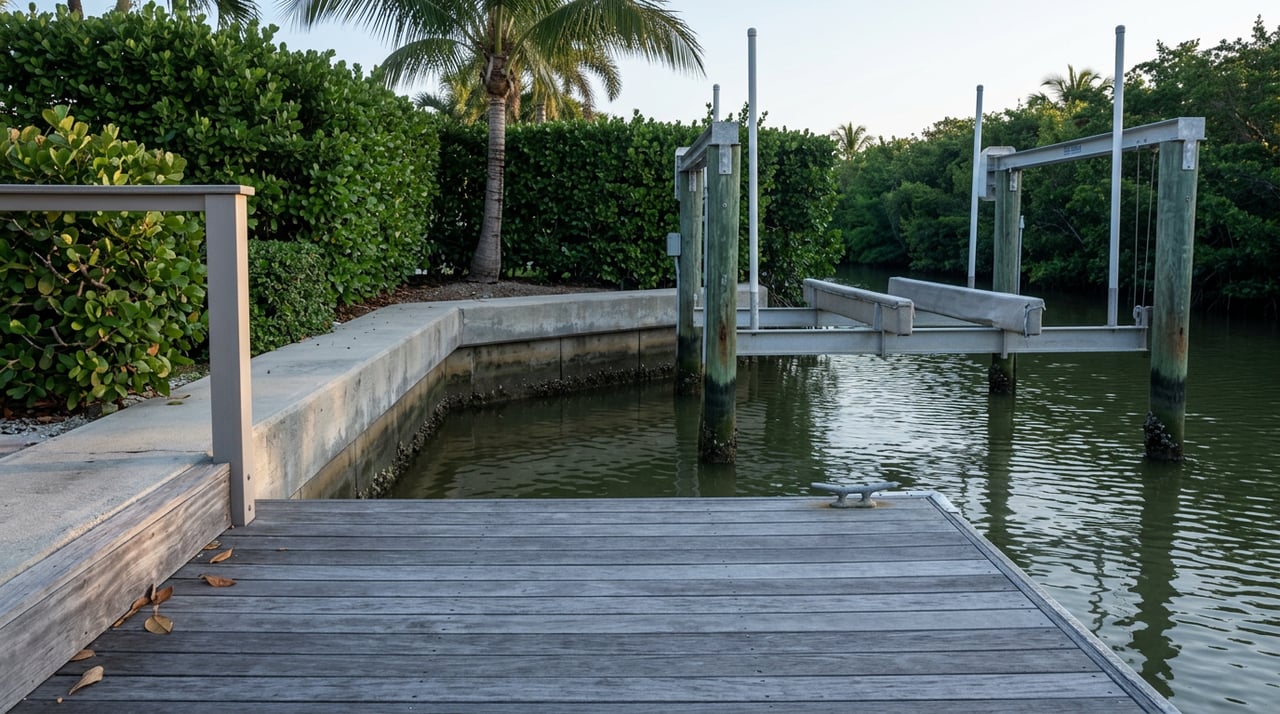
Ask a longtime canal owner what two decades of no dredging feels like and you get something more specific than a budget line. Jay Plager, a Country Club Shores resident, told a Longboat Key reporter that canal access was the whole reason he and his wife Lynne bought their home, describing it as a lifelong fantasy dating back to when he was 13 and first owned a boat. What he didn't expect was the sediment.
The beams on his original boat lift sat nearly two and a half feet below the hull, which meant he needed more clearance than the silted canal could reliably provide. He upgraded to a lift with bow-shaped beams designed to avoid the buildup around the pilings, replaced the bulkhead, and built a larger dock around the new lift.
"With the old lift, I had a problem getting off at low tide," Plager said. "It was fairly expensive, but that's what we want. And it's worth the investment."
That's the private version of the cost the town is now trying to solve collectively. Boat captains elsewhere on the island have described a similar problem in blunter terms: leave on a low tide and you may not be able to get back in until the water rises again. A canal that only works on a favorable tide is a canal that isn't fully doing its job, and Country Club Shores markets itself as a boater's neighborhood precisely because its docks are supposed to be reliable, not conditional.
The $620 fee, in that light, isn't really a new cost so much as a shift in who pays for something owners have already been paying for privately, one bulkhead and one boat lift at a time.
Why a flat fee lands differently in this particular neighborhood
Here's the detail that matters most if you're comparing homes within Country Club Shores rather than deciding whether to buy here at all: the $620 EBU charge is a flat, per-parcel fee. It does not move with your home's assessed value. Only the much smaller millage slice does that.
That's a minor detail in a neighborhood of uniformly priced new construction. It's a much bigger one in Country Club Shores, where a 1967 ranch on Gunwale Lane can sit two streets away from a five-bedroom home built in 2026 on Chipping Lane, and where prices among currently listed homes have ranged from roughly $2.1 million for an older three-bedroom to $9.4 million for new construction on Putter Lane. The flat fee doesn't know the difference between those two houses. It sees a boat ramp, existing or potential, and bills the same $620 either way.
Practically, that means the assessment takes a proportionally larger bite out of the neighborhood's more modest, often older canal homes than it does out of its newest and most expensive builds. If you're weighing a smaller original-era home against a rebuild on a similar canal, the dredging fee itself won't be the deciding factor, but it's one more place where the math between an entry-level Country Club Shores property and a top-tier one is closer than the price difference alone would suggest.
What the fee is protecting
None of this happens in a vacuum from the thing that makes these homes valuable in the first place. Appraisers who specialize in waterfront property treat usable depth at mean low tide as a core driver of value, not a footnote, and industry analyses of waterfront markets nationally put the premium for genuine, reliable water access at 30 to 50 percent over comparable inland homes. A new composite dock with a substantial lift can add as much as $250,000 to a canal home's resale value on its own.
The dredging assessment is, in effect, underwriting the asset that commands that premium. A canal that silts back up over another two decades doesn't just create inconvenience like Jay Plager's. It threatens the reliable depth that the entire price differential between a Country Club Shores canal home and a comparable inland property depends on.
What the bill might look like later
Longboat Key's plan is built with a step-down: the $620 fee falls to $318 after the first five years, once the initial restoration work is done and the program shifts into ongoing maintenance. That's the town's stated intention, and it's worth taking seriously since it's written into the funding resolution itself.
It's also worth knowing what happened in a market that built a similar system decades ago. Punta Gorda Isles has run its own canal maintenance district since 1996, funding seawall repair and dredging through an annual special assessment on waterfront owners. That single-family assessment rose from $460 in 2021 to $1,350 in 2026, nearly tripling in five years, driven largely by aging seawalls and rising construction costs. Longboat Key's program doesn't include seawall work the way Punta Gorda's does, which is a real structural difference. But it's a useful data point for anyone assuming the $318 figure is a permanent ceiling rather than a starting point for the maintenance phase.
A few questions worth asking before you make an offer
Does the fee change based on how much I pay for the home? No. The $620 EBU charge is flat per qualifying parcel. Only the smaller millage portion moves with assessed value.
If I close before November 2026, will I still owe it? The assessment is billed annually going forward, so a home you own after November 2026 will carry the charge regardless of when you closed. The issue isn't whether you owe it. It's that a tax record pulled before the bill exists won't show it, so ask directly rather than relying on the prior year's tax bill alone.
When will dredging actually happen in my canal? The town's plan calls for physical dredging to begin roughly three years after collection starts, putting most work around 2029 under the current schedule, sooner if outside funding comes through first.
Country Club Shores earned its reputation as a boating neighborhood the honest way, with deep canals that Arvida cut on purpose and owners who've spent decades keeping their own docks workable while the town caught up. The assessment headed for November mailboxes is the town finally catching up. Understanding how it's structured, and how it lands differently across a neighborhood with sixty years of homes on the same canals, is part of buying here with clear eyes.
If you're weighing a canal-front purchase in Country Club Shores or anywhere else on Longboat Key, Bruce Myer Group can walk through what a specific parcel's assessment picture looks like before you're under contract. Talk with us about your real estate plans.